Personalized Learning: Why Every Student Learns Differently
Introduction
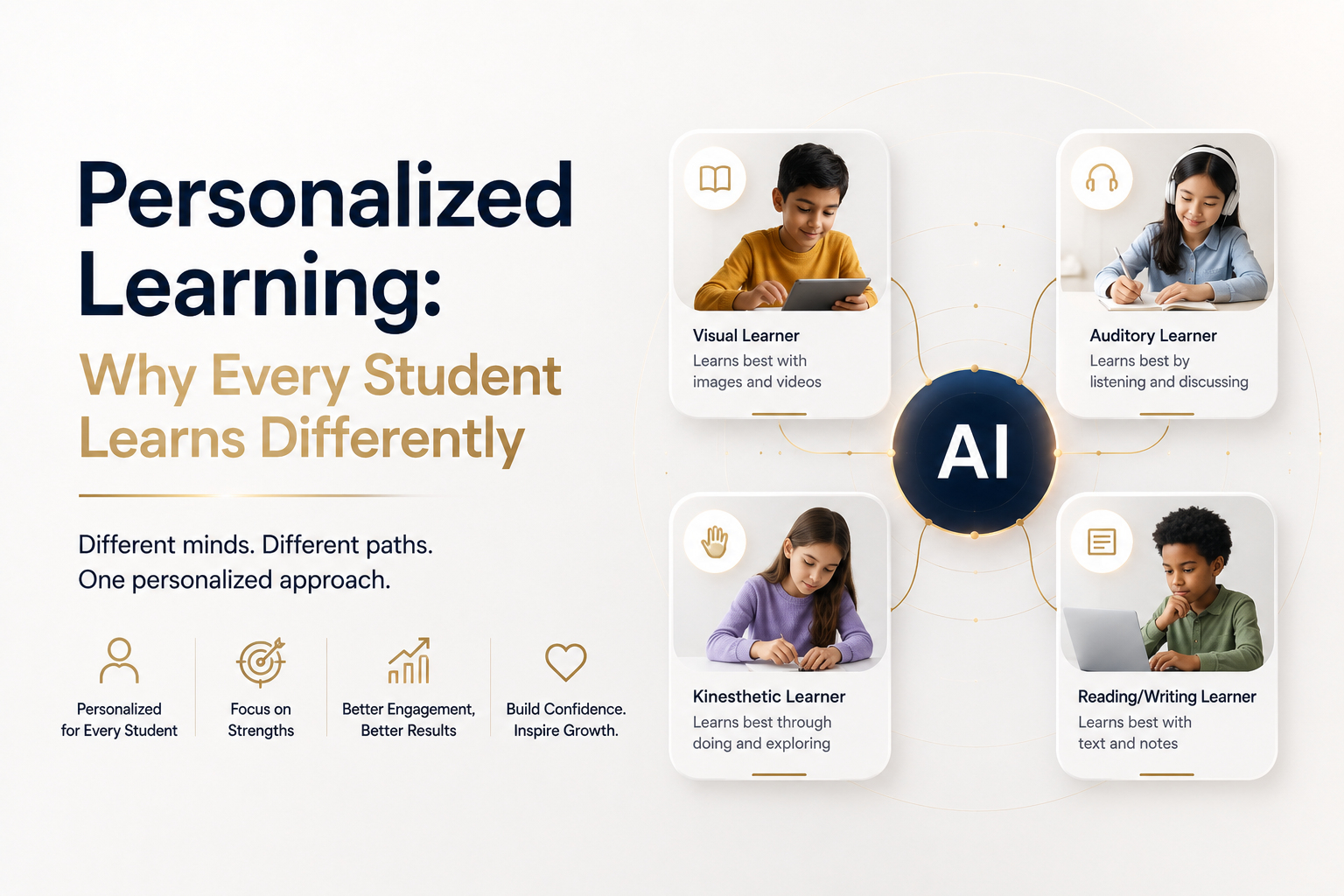
Walk into any classroom, and you will immediately notice something remarkable: no two students are exactly alike. Some students quickly grasp mathematical concepts, while others excel in language and communication. Some learn best through visual demonstrations, while others prefer reading, listening, or hands-on experiences.
Despite these differences, traditional education systems have historically followed a standardized approach to teaching. Students are often expected to learn the same content, at the same pace, and in the same way. While this model has worked for many years, it does not always accommodate the unique needs of every learner.
As education evolves, there is growing recognition that students learn differently and require personalized support to reach their full potential. Advances in technology and artificial intelligence are making personalized learning more accessible than ever before.
Personalized learning represents a shift from a one-size-fits-all approach to a student-centered model that adapts to individual needs, strengths, and goals.
In this article, we explore why every student learns differently, how personalized learning works, and how AI is transforming education through customized learning experiences.
Understanding Learning Differences
Every student is unique.
Students differ in many ways, including:
These differences influence how students absorb, process, and retain information.
For example:
- Learning speed
- Prior knowledge
- Interests and motivations
- Cognitive abilities
- Academic strengths
- Learning styles
- Cultural backgrounds
- Personal goals
Student A
May understand scientific concepts quickly but struggle with writing essays.
Student B
May excel in language and communication but require additional support in mathematics.
Student C
May learn best through visual diagrams and videos rather than text-based explanations.
Treating all students identically often ignores these differences and can limit learning outcomes.
Recognizing and accommodating learning diversity is essential for creating effective educational experiences.
Why Traditional Education Faces Challenges
Traditional education systems were designed to teach large groups of students efficiently.
In many classrooms:
While this model provides structure and consistency, it also creates challenges.
- One teacher teaches dozens of students.
- The same lesson is delivered to everyone.
- Assessments are standardized.
- Learning pace is fixed.
Fast Learners
Students who quickly understand concepts may become bored and disengaged.
Struggling Learners
Students who require more time may fall behind and lose confidence.
Limited Individual Attention
Teachers often have limited time to provide personalized support to every learner.
Uniform Assessments
Traditional assessments may not accurately reflect individual learning styles and strengths.
As a result, some students thrive while others struggle unnecessarily.
What Is Personalized Learning?
Personalized learning is an educational approach that tailors instruction, content, pace, and support to meet the unique needs of each student.
Instead of expecting students to adapt to the education system, personalized learning adapts education to the student.
Key characteristics include:
Individual Learning Paths
Students follow customized learning journeys based on their abilities and goals.
Flexible Learning Pace
Students progress at a speed that matches their understanding.
Targeted Support
Additional resources are provided where needed.
Continuous Feedback
Students receive ongoing insights about their progress.
Goal-Oriented Learning
Learning experiences align with personal objectives and interests.
Personalized learning recognizes that success looks different for every learner.
The Role of AI in Personalized Learning
Artificial Intelligence is making personalized learning scalable and practical.
Without technology, providing individualized instruction to hundreds or thousands of students would be extremely difficult.
AI helps by analyzing large amounts of educational data and identifying patterns that humans may miss.
AI-powered learning platforms can:
These capabilities allow educational experiences to be tailored automatically to each student's needs.
Platforms such as QuizerAi use AI to provide personalized quizzes, performance analytics, and learning recommendations that help students improve more effectively.
- Monitor performance
- Track engagement
- Identify learning gaps
- Recommend resources
- Generate assessments
- Adapt content difficulty
Learning Analytics and Student Insights
One of the most powerful aspects of AI-powered education is learning analytics.
Learning analytics involves collecting and analyzing data about student performance.
This may include:
AI systems transform this data into meaningful insights.
For example:
A student may appear to be performing adequately overall but consistently struggle with specific topics.
Traditional grading systems may overlook this issue.
AI analytics can identify:
- Quiz results
- Assignment scores
- Attendance records
- Study patterns
- Time spent learning
- Topic mastery
- Weak concepts
- Learning trends
- Progress over time
- Areas requiring intervention
These insights help students and teachers make better educational decisions.
Customized Study Recommendations
Every student has different academic needs.
A student preparing for a mathematics exam requires different support than a student struggling with language skills.
AI-powered platforms generate customized recommendations based on individual performance.
Examples include:
Personalized Quizzes
Questions targeting weak topics.
Revision Plans
Study schedules designed around learning gaps.
Learning Resources
Videos, articles, and exercises relevant to student needs.
Practice Exercises
Additional questions focusing on difficult concepts.
This targeted support increases learning efficiency and reduces wasted effort.
Students spend more time working on areas that matter most.
Benefits for Students
Personalized learning offers numerous advantages.
Improved Understanding
Students receive explanations tailored to their level of knowledge.
Higher Engagement
Learning becomes more relevant and interesting.
Increased Confidence
Students experience success more frequently.
Better Academic Performance
Targeted support helps improve outcomes.
Greater Independence
Students take ownership of their learning journey.
Reduced Stress
Learning at an appropriate pace reduces frustration and anxiety.
Ultimately, students become more motivated and capable learners.
Benefits for Teachers
Personalized learning also benefits educators.
Better Visibility
Teachers gain deeper insights into student performance.
Efficient Intervention
Learning gaps can be identified quickly.
Reduced Administrative Work
AI automates data analysis and reporting.
Enhanced Teaching Effectiveness
Teachers can focus on providing targeted support.
Improved Classroom Outcomes
Students receive assistance exactly where needed.
Rather than replacing teachers, personalized learning technologies empower them to make better instructional decisions.
Real-World Applications of Personalized Learning
Personalized learning is already transforming education around the world.
AI Tutors
Provide instant assistance and explanations.
Adaptive Learning Platforms
Adjust content difficulty based on performance.
Personalized Assessments
Generate questions aligned with individual needs.
Smart Revision Systems
Recommend topics requiring additional attention.
Student Dashboards
Provide real-time performance tracking.
Educational platforms such as QuizerAi bring many of these capabilities together in a single learning ecosystem.
Future Trends in Personalized Learning
The future of education will become increasingly personalized.
Emerging trends include:
Hyper-Personalized Learning
AI systems will adapt every aspect of the educational experience.
Predictive Learning Support
Systems will anticipate learning challenges before they occur.
Emotion-Aware AI
Educational tools may detect frustration, confusion, or disengagement.
Intelligent Career Guidance
Students will receive personalized academic and career recommendations.
Lifelong Learning Ecosystems
Personalized learning will extend beyond school into professional development and continuous education.
These innovations will make education more adaptive and effective than ever before.
Challenges and Considerations
While personalized learning offers significant benefits, implementation requires careful planning.
Challenges include:
Data Privacy
Student information must be protected securely.
Accessibility
Technology should be available to all learners.
Teacher Training
Educators must understand how to use personalized learning tools effectively.
Ethical AI Usage
Algorithms should be transparent and fair.
Addressing these challenges is essential for maximizing the benefits of personalized education.
Conclusion
Every student learns differently, and education should reflect that reality.
Traditional one-size-fits-all approaches often fail to meet the diverse needs of modern learners. Personalized learning offers a more effective alternative by adapting instruction, content, and support to individual strengths, weaknesses, and goals.
Artificial Intelligence is making personalized learning possible at scale. Through learning analytics, adaptive assessments, customized recommendations, and intelligent tutoring systems, students receive the support they need to succeed while teachers gain valuable insights to improve instruction.
As educational technology continues to evolve, personalized learning will become a cornerstone of modern education.
The future belongs to learning environments that recognize individual differences, empower students, and provide every learner with the opportunity to reach their full potential.
Key Takeaway
Personalized learning ensures every student receives the support, guidance, and opportunities they need to learn effectively, build confidence, and achieve success.
About the author
Jay Kumar
Co-founder, QuizerAi
Jay Kumar is the co-founder of QuizerAi, where he focuses on building AI-powered tools that help teachers save time and students learn more effectively. He writes about the future of education, personalized learning, and how technology can make classrooms smarter and more accessible.