Smart Revision Strategies for Better Exam Results
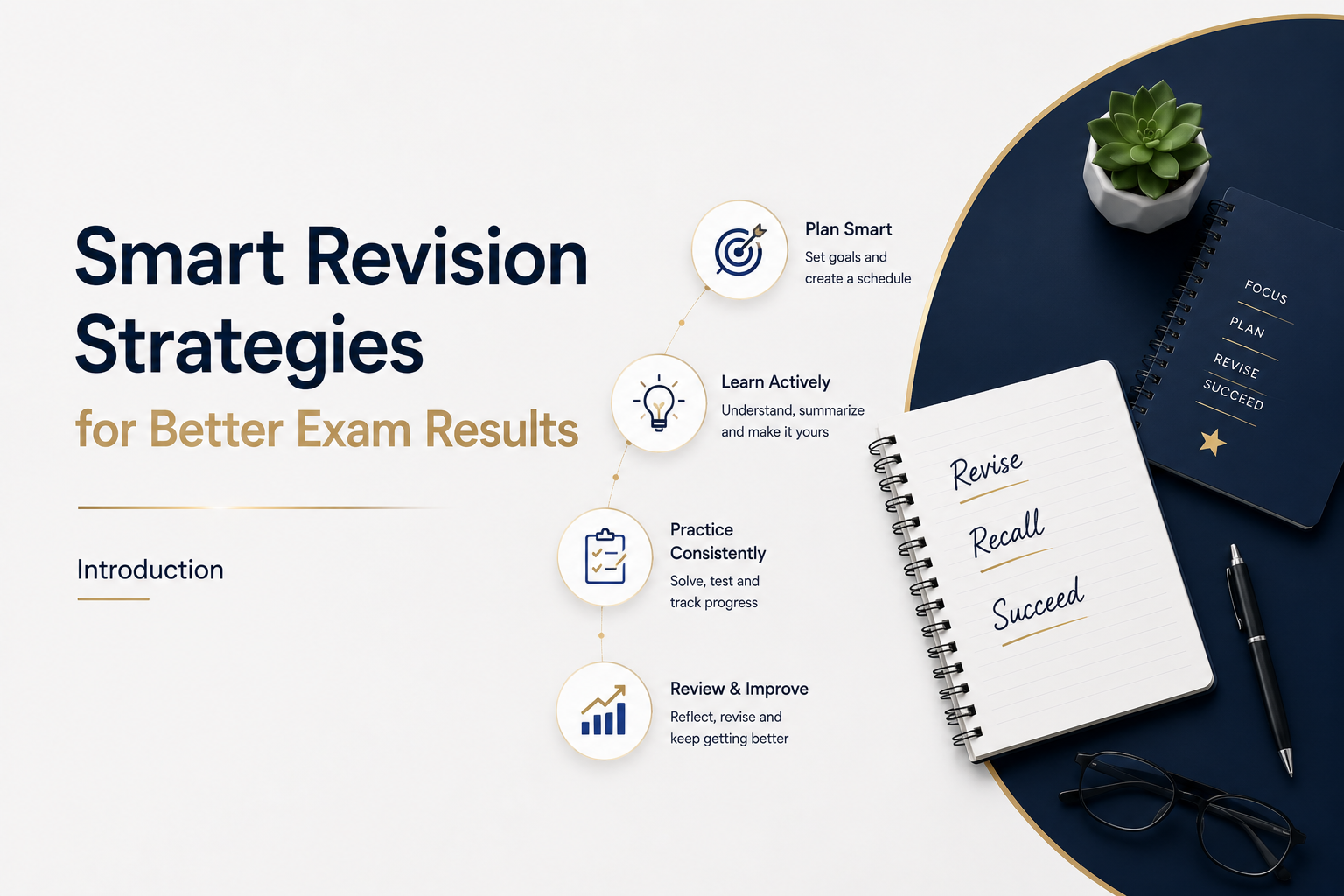
Introduction
Every year, millions of students spend countless hours preparing for exams. They read textbooks repeatedly, highlight pages with colorful markers, create lengthy notes, and dedicate entire days to studying. Yet despite their efforts, many students fail to achieve the results they expect.
Why does this happen?
The answer is simple: studying longer does not always mean studying smarter.
Many students rely on revision methods that feel productive but are actually ineffective for long-term learning and memory retention. Reading the same notes multiple times may create a false sense of familiarity, but it does not necessarily improve understanding or recall during an examination.
Modern educational research has revealed that effective revision is not about the number of hours spent studying. Instead, it is about using scientifically proven learning strategies that improve memory, understanding, and exam performance.
In today's educational landscape, students also have access to AI-powered learning tools, personalized revision plans, intelligent quizzes, and performance analytics that make revision more effective than ever before.
This article explores the most effective revision strategies, explains why traditional methods often fail, and demonstrates how students can use smart learning techniques to achieve better exam results.
Why Traditional Revision Often Fails
Many students approach revision in ways that seem productive but provide limited benefits.
Common revision habits include:
These approaches create a feeling of familiarity with the material but often fail to strengthen long-term memory.
For example:
A student may read a chapter five times and feel confident because the content appears familiar.
However, during the exam, they may struggle to recall key concepts because they never actively practiced retrieving the information.
This phenomenon is known as the "illusion of learning."
Students mistake recognition for understanding.
Effective revision requires active engagement with the material rather than passive review.
- Reading textbooks repeatedly
- Highlighting large sections of content
- Memorizing without understanding
- Studying for long hours without breaks
- Focusing only on favorite subjects
Understanding How Memory Works
To revise effectively, students must understand how memory functions.
The learning process generally involves three stages:
Encoding
Information enters the brain through reading, listening, or observation.
Storage
The brain organizes and stores information for future use.
Retrieval
Information is recalled when needed.
Examinations primarily test retrieval ability.
Therefore, successful revision should focus on strengthening retrieval rather than simply increasing exposure to information.
The more often students actively retrieve information, the stronger their memory becomes.
Active Recall: The Most Powerful Revision Technique
Active recall is widely considered one of the most effective learning strategies.
Instead of repeatedly reviewing information, students actively test themselves.
Examples include:
Active recall forces the brain to retrieve information, strengthening memory pathways.
- Answering questions without notes
- Solving practice problems
- Writing summaries from memory
- Explaining concepts aloud
Example
Ineffective Approach:
Read a biology chapter three times.
Effective Approach:
Read the chapter once, close the book, and write down everything remembered.
The second method creates stronger memory retention.
Research consistently shows that active recall significantly improves long-term learning and exam performance.
Spaced Repetition: Learning Over Time
One of the biggest mistakes students make is cramming.
Cramming involves studying large amounts of material in a short period.
While it may produce short-term results, information is often forgotten quickly.
Spaced repetition solves this problem.
What Is Spaced Repetition?
Spaced repetition involves reviewing information at increasing intervals.
Example schedule:
- Day 1: Learn concept
- Day 3: Review
- Day 7: Review again
- Day 14: Review again
- Day 30: Final review
Each review strengthens memory and reduces forgetting.
Spaced repetition works because it aligns with the brain's natural forgetting curve.
Students who use spaced repetition retain information longer and require less overall study time.
Practice Testing and Mock Exams
One of the best ways to prepare for an exam is to simulate the exam itself.
Practice testing provides several benefits:
Improves Recall
Students actively retrieve information.
Builds Confidence
Familiarity with exam formats reduces anxiety.
Identifies Weak Areas
Students discover topics requiring additional revision.
Enhances Time Management
Students learn how to manage exam time effectively.
- Topic quizzes
- Chapter tests
- Previous year papers
- Full-length mock examinations
Methods include:
Platforms such as QuizerAi can automatically generate personalized quizzes that help students assess their readiness and improve weak areas.
Creating Effective Study Plans
Many students begin revision without a structured plan.
This often results in:
A good revision plan should include:
- Wasted time
- Uneven subject coverage
- Last-minute stress
Clear Goals
Define what needs to be achieved.
Prioritization
Focus on high-weightage and weak topics first.
Daily Study Sessions
Create realistic and achievable targets.
Revision Cycles
Schedule regular reviews using spaced repetition.
Breaks and Recovery
Avoid burnout by including rest periods.
Effective planning improves productivity and reduces stress.
AI-Powered Revision Tools
Artificial Intelligence is transforming revision strategies.
Modern AI learning platforms can provide:
Personalized Revision Plans
Customized schedules based on performance.
AI Quiz Generation
Instant quizzes from any chapter or topic.
Smart Summaries
Condensed notes highlighting key concepts.
Performance Analytics
Insights into strengths and weaknesses.
Adaptive Learning
Questions automatically adjust based on skill level.
- Recommend additional practice
- Generate targeted quizzes
- Suggest revision materials
- Track improvement over time
For example:
If a student struggles with Algebra, the AI system can:
This level of personalization makes revision significantly more effective.
Personalized Revision Strategies
Every student learns differently.
A revision strategy that works for one student may not work for another.
Visual Learners
Benefit from:
- Diagrams
- Mind maps
- Infographics
- Videos
Auditory Learners
Prefer:
- Recorded explanations
- Discussions
- Verbal repetition
Reading/Writing Learners
Learn through:
- Notes
- Summaries
- Written practice
Practical Learners
Prefer:
- Problem-solving
- Simulations
- Experiments
Personalized revision ensures students use methods that align with their learning preferences.
Time Management During Exam Preparation
Effective revision requires effective time management.
Many students underestimate how much time is required to prepare properly.
Prioritize Important Topics
Focus on high-impact concepts first.
Use Time Blocks
Study in focused sessions.
Example:
- 50 minutes study
- 10 minutes break
Avoid Multitasking
Concentrate on one subject at a time.
Set Deadlines
Create accountability and maintain progress.
Track Performance
Monitor completion of revision goals.
Good time management improves productivity while reducing stress.
Common Revision Mistakes to Avoid
Many students unknowingly make mistakes that reduce revision effectiveness.
Passive Reading
Reading without testing understanding.
Cramming
Trying to learn everything at the last moment.
Ignoring Weak Areas
Focusing only on comfortable topics.
Lack of Practice Questions
Avoiding active problem-solving.
No Revision Plan
Studying without structure.
Studying for Too Long
Excessive study sessions reduce concentration and retention.
Avoiding these mistakes can dramatically improve learning outcomes.
The Role of Confidence in Exam Success
Knowledge alone does not guarantee success.
Confidence plays a crucial role in examination performance.
Students who:
tend to feel more confident during exams.
Confidence reduces anxiety and improves decision-making under pressure.
Smart revision strategies build both competence and confidence.
- Practice regularly
- Track progress
- Complete mock exams
- Understand concepts deeply
The Future of Revision: AI-Powered Learning
The future of revision is becoming increasingly personalized and intelligent.
Emerging technologies will provide:
Educational platforms like QuizerAi are already helping students revise smarter through AI-generated quizzes, performance insights, personalized study recommendations, and intelligent learning support.
The future belongs to students who leverage technology to learn more effectively.
- Real-time learning recommendations
- Predictive performance analysis
- Personalized revision pathways
- AI tutors available 24/7
- Automated progress tracking
Conclusion
Exam success is not determined by how many hours a student studies but by how effectively those hours are used.
Traditional revision methods often fail because they rely on passive learning techniques that do not strengthen memory or understanding. Smart revision strategies such as active recall, spaced repetition, practice testing, structured planning, and AI-powered learning tools provide a more effective path to academic success.
Students who revise strategically retain information longer, understand concepts more deeply, and approach examinations with greater confidence.
As educational technology continues to evolve, AI-powered platforms like QuizerAi will play an increasingly important role in helping students learn smarter, revise more efficiently, and achieve their academic goals.
Key Takeaway
Smart revision techniques can significantly improve retention, confidence, and exam performance. Success is not about studying harder—it is about studying smarter.
About the author
Jay Kumar
Co-founder, QuizerAi
Jay Kumar is the co-founder of QuizerAi, where he focuses on building AI-powered tools that help teachers save time and students learn more effectively. He writes about the future of education, personalized learning, and how technology can make classrooms smarter and more accessible.