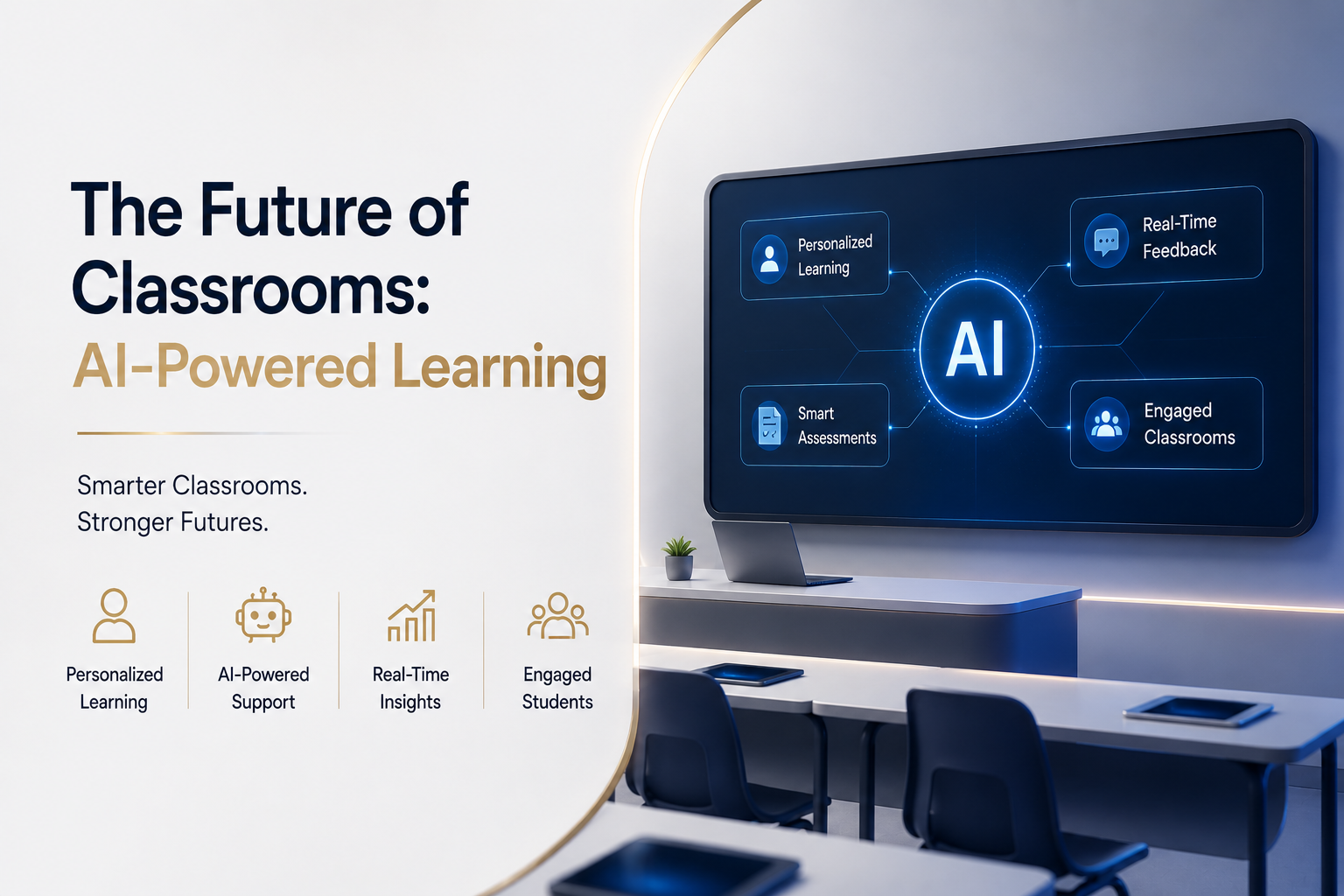
The Future of Classrooms: AI-Powered Learning
Introduction
Education has always evolved alongside technology. From blackboards and printed textbooks to computers and online learning platforms, each technological advancement has transformed the way knowledge is delivered and consumed. Today, we stand at the beginning of another educational revolution—one driven by Artificial Intelligence (AI).
The traditional classroom model, while effective for decades, faces significant challenges in meeting the diverse needs of modern learners. Students learn at different speeds, possess different strengths and weaknesses, and require varying levels of support. Teachers, meanwhile, must manage growing administrative responsibilities while striving to provide personalized attention to every student.
Artificial Intelligence is emerging as a powerful solution to these challenges. By automating repetitive tasks, personalizing learning experiences, and providing real-time insights, AI is helping create smarter, more efficient, and more engaging learning environments.
The future classroom will not simply be a digital version of today's classroom. It will be an intelligent ecosystem where technology supports teachers, empowers students, and enhances educational outcomes.
In this article, we explore how AI is transforming classrooms and what the future of education may look like in the coming years.
The Evolution of Education Technology
Education has undergone several technological transformations throughout history.
Traditional Learning Era
For centuries, education relied heavily on:
- Chalkboards
- Printed books
- Teacher-centered instruction
- Paper-based assessments
While effective, these methods offered limited personalization and scalability.
Digital Learning Era
The introduction of computers and the internet transformed education significantly.
Schools adopted:
- Smart boards
- Online learning platforms
- Educational software
- Digital assessments
- Video-based learning
These technologies improved accessibility but still largely followed a one-size-fits-all approach.
The AI Era
Today, AI is taking educational technology to the next level.
Instead of simply digitizing learning materials, AI systems can:
- Understand student behavior
- Personalize instruction
- Generate educational content
- Provide instant feedback
- Predict learning outcomes
This shift marks the beginning of truly intelligent learning environments.
What Are Smart Classrooms?
A smart classroom is a technology-enhanced learning environment that uses digital tools, data, and artificial intelligence to improve teaching and learning experiences.
Unlike traditional classrooms, smart classrooms actively support both teachers and students.
Features of smart classrooms include:
The goal is not to replace teachers but to empower them with tools that make education more effective and engaging.
- AI-powered learning platforms
- Interactive digital content
- Automated assessments
- Real-time performance tracking
- Virtual learning assistants
- Data-driven decision-making
AI in Personalized Learning
One of the most powerful applications of AI in education is personalized learning.
Traditional classrooms often require all students to follow the same curriculum at the same pace.
However, every student learns differently.
Some students:
- Learn quickly
- Require visual explanations
- Need additional practice
- Excel in specific subjects
How Personalized Learning Works
AI analyzes individual learning patterns and adapts educational content accordingly.
AI systems collect data such as:
- Quiz results
- Assignment performance
- Learning speed
- Topic mastery
- Engagement levels
Based on this information, AI can:
- Recommend learning resources
- Adjust difficulty levels
- Generate targeted practice questions
- Suggest revision plans
As a result, students receive learning experiences tailored to their specific needs.
Virtual Learning Assistants
One of the most exciting developments in AI-powered education is the emergence of virtual learning assistants.
These AI-powered assistants function as always-available educational companions.
Students can:
Unlike traditional tutoring, virtual assistants are available 24 hours a day.
For example:
A student preparing for an examination at midnight can instantly receive help with difficult concepts without waiting for a teacher or tutor.
This accessibility significantly improves learning continuity and student confidence.
- Ask questions
- Request explanations
- Practice concepts
- Generate quizzes
- Receive study recommendations
Real-Time Performance Tracking
Traditional educational systems often rely on periodic assessments to evaluate student performance.
Unfortunately, this means learning problems may go unnoticed for weeks or even months.
AI-powered classrooms change this by providing real-time performance tracking.
Teachers can instantly monitor:
Students can also access dashboards that display:
- Quiz performance
- Assignment completion
- Attendance patterns
- Learning progress
- Engagement levels
- Strengths
- Weaknesses
- Progress trends
- Learning goals
This immediate visibility enables faster interventions and more effective support.
Predictive Analytics in Education
One of the most transformative capabilities of AI is predictive analytics.
Predictive analytics uses historical data to forecast future outcomes.
In education, this means AI can identify students who may be at risk of:
For example:
If a student's attendance drops while assessment scores decline, the AI system can alert teachers before the situation becomes serious.
This proactive approach allows educators to provide timely support and improve student success rates.
- Falling behind academically
- Missing assignments
- Low exam performance
- Reduced engagement
AI-Powered Assessment and Feedback
Assessment is an essential part of learning.
However, traditional assessment methods often involve:
AI addresses these issues through intelligent assessment systems.
AI-powered platforms can:
- Delayed feedback
- Manual grading
- Limited personalization
- Generate quizzes automatically
- Evaluate responses instantly
- Provide personalized feedback
- Recommend learning resources
Students no longer need to wait days or weeks to understand their mistakes.
Immediate feedback helps learners improve more quickly and effectively.
Benefits for Schools and Teachers
AI-powered classrooms provide numerous advantages for educational institutions and educators.
Reduced Administrative Workload
Teachers spend less time on:
- Grading
- Attendance management
- Report generation
- Assessment creation
Better Decision-Making
Administrators gain access to valuable educational insights and performance trends.
Improved Student Outcomes
Personalized learning experiences help students perform better academically.
Increased Engagement
Interactive AI-powered learning tools make education more engaging and enjoyable.
Scalability
Schools can provide personalized support to larger numbers of students without significantly increasing resources.
Emerging Trends in AI-Powered Education
The educational technology landscape continues to evolve rapidly.
Several emerging trends are shaping the future of learning.
AI Content Generation
Teachers can automatically generate:
- Question papers
- Assignments
- Worksheets
- Lesson plans
Intelligent Tutoring Systems
Advanced AI tutors provide personalized support and adaptive learning experiences.
Gamified Learning
AI-powered educational games increase engagement and motivation.
Voice-Based Learning
Students interact with educational systems using natural speech.
Multilingual Learning
AI translation technologies make educational content accessible in multiple languages.
Future Possibilities
The future classroom will be significantly more intelligent than today's learning environments.
Potential developments include:
Hyper-Personalized Education
Every student receives a unique learning journey tailored to their abilities and goals.
Emotion-Aware Learning Systems
AI may detect frustration, confusion, or disengagement and adapt accordingly.
AI-Powered Career Guidance
Students receive personalized recommendations based on interests, strengths, and performance.
Immersive Learning Experiences
Virtual reality and augmented reality will combine with AI to create highly interactive learning environments.
Continuous Learning Ecosystems
Learning will extend beyond classrooms and become a lifelong, AI-supported experience.
Challenges and Ethical Considerations
While AI offers enormous benefits, responsible implementation is essential.
Educational institutions must address:
AI should serve as a tool that enhances education rather than replacing the human relationships that are central to learning.
Teachers will continue to play a critical role as mentors, motivators, and guides.
- Data privacy
- Security concerns
- Algorithm transparency
- Ethical AI usage
- Digital accessibility
Conclusion
The future of education is becoming increasingly intelligent, personalized, and student-centered.
Artificial Intelligence is transforming classrooms by providing adaptive learning experiences, virtual tutors, predictive analytics, automated assessments, and real-time insights. These innovations are helping educators reduce administrative workload while enabling students to learn more effectively.
The classroom of the future will not be defined by technology alone. Instead, it will combine the strengths of human educators with the capabilities of artificial intelligence to create richer and more meaningful learning experiences.
Platforms like QuizerAi represent the next generation of educational technology, empowering teachers to focus on teaching and helping students unlock their full potential through personalized learning and intelligent support.
Key Takeaway
Future classrooms will be more intelligent, interactive, personalized, and student-centered than ever before. AI will not replace teachers—it will empower them to create better learning experiences and achieve stronger educational outcomes.
About the author
Jay Kumar
Co-founder, QuizerAi
Jay Kumar is the co-founder of QuizerAi, where he focuses on building AI-powered tools that help teachers save time and students learn more effectively. He writes about the future of education, personalized learning, and how technology can make classrooms smarter and more accessible.